

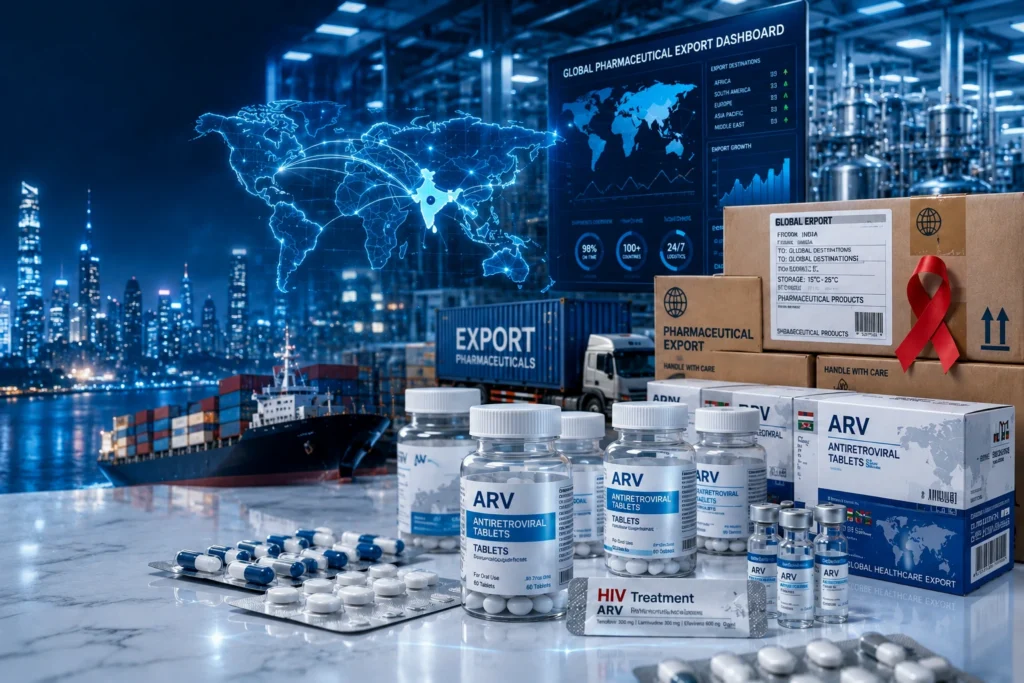
India has emerged as one of the most trusted pharmaceutical manufacturing hubs in the world. With decades of expertise in generic drug production, the country now accounts for a significant share of global medicine supply, particularly in antiretroviral (ARV) therapy. Nations across Africa, Southeast Asia, the Middle East, and Latin America increasingly rely on Indian pharmaceutical exporters to meet their HIV treatment needs at affordable costs without compromising on quality.
The global demand for antiretroviral medicines continues to rise as millions of people living with HIV/AIDS require sustained access to effective treatment. India plays a pivotal role in bridging this gap by offering WHO-GMP certified ARV formulations, robust export infrastructure, and the production capacity to serve both government tenders and private healthcare sectors worldwide.
Why India Is a Global Hub for ARV Medicine Export
India’s pharmaceutical sector did not achieve global recognition by chance. It is the result of decades of investment in manufacturing infrastructure, regulatory compliance, and skilled technical workforce. Several factors position India as the preferred source for ARV medicines across international markets.
Certified Manufacturing Standards
A large number of Indian pharmaceutical manufacturers operate facilities certified under WHO-Good Manufacturing Practices (WHO-GMP). This certification ensures that the production environment, raw material sourcing, quality control, and final product packaging all meet internationally accepted standards. Many facilities also hold certifications from USFDA, EMA (European Medicines Agency), and other regulatory bodies, making Indian ARV products acceptable in highly regulated markets.
Cost-Effective Generic Production
India’s strength in active pharmaceutical ingredient (API) synthesis and generic formulation allows manufacturers to produce high-quality ARV drugs at a fraction of the cost compared to originator brands. This cost advantage is not a result of cutting corners on quality but stems from efficient manufacturing processes, economies of scale, and a competitive API supply chain within the country itself.
DCGI-Approved and Export-Ready Formulations
Medicines exported from India carry approvals from the Drug Controller General of India (DCGI), ensuring that every formulation meets domestic regulatory standards before reaching international buyers. Combined with compliance under PEPFAR (President’s Emergency Plan for AIDS Relief) guidelines for select products, Indian ARV exporters are well-positioned to fulfill government procurement contracts and NGO supply agreements globally.
Strong Export Reach Across Key Regions
Indian pharmaceutical exporters have established distribution networks reaching Sub-Saharan Africa, East and West Africa, the Middle East, Southeast Asia, and Latin America. Countries including Nigeria, Kenya, Uganda, Ethiopia, Jordan, Tanzania, and Cambodia are among the consistent importers of Indian ARV medicines. This geographic reach, supported by reliable freight and cold chain logistics, makes India a dependable long-term supply partner.
What Are ARV Drugs?
Antiretroviral (ARV) drugs are medicines used in the management of HIV (Human Immunodeficiency Virus) infection. These medicines do not cure HIV but work by suppressing viral replication within the human body. When taken consistently as prescribed, ARV therapy significantly reduces the viral load in the bloodstream, allowing the immune system to remain functional and preventing the progression to AIDS (Acquired Immunodeficiency Syndrome).
ARV treatment typically involves a combination of drugs from different classes, a strategy known as combination antiretroviral therapy or cART. This approach reduces the risk of the virus developing resistance to any single drug and is the current global standard for HIV management. Fixed-dose combination (FDC) tablets, which combine two or three ARV drugs in a single pill, have greatly improved patient adherence and simplified treatment protocols, particularly in resource-limited settings.
ARV medicines are broadly categorized based on their mechanism of action, including Nucleoside/Nucleotide Reverse Transcriptase Inhibitors (NRTIs), Non-Nucleoside Reverse Transcriptase Inhibitors (NNRTIs), Protease Inhibitors (PIs), and Integrase Strand Transfer Inhibitors (INSTIs). India produces and sells products spanning all these categories of drugs.
Common ARV Drugs Exported from India
The following table provides an overview of the antiretroviral medicines most commonly supplied by Indian pharmaceutical exporters to international healthcare markets:
ARV Drug Name | Drug Category | Common Usage |
Tenofovir (TDF) | NRTI | First-line HIV treatment; widely used in combination therapy |
Lamivudine (3TC) | NRTI | Combination ARV therapy; also used for Hepatitis B |
Dolutegravir (DTG) | Integrase Inhibitor | Preferred first-line HIV treatment globally |
Efavirenz (EFV) | NNRTI | Antiviral therapy; part of fixed-dose combinations |
Zidovudine (AZT) | NRTI | HIV management; used in prevention of mother-to-child transmission |
Abacavir (ABC) | NRTI | Antiretroviral therapy in adults and pediatric patients |
Nevirapine (NVP) | NNRTI | HIV infection management; used in developing countries |
Ritonavir (RTV) | Protease Inhibitor | Used as a pharmacokinetic booster in combination regimens |
Lopinavir (LPV) | Protease Inhibitor | HIV infection control in combination with Ritonavir |
Atazanavir (ATV) | Protease Inhibitor | Once-daily HIV treatment option for adult patients |
Emtricitabine (FTC) | NRTI | Fixed-dose combination ARV therapy with Tenofovir |
Darunavir (DRV) | Protease Inhibitor | Treatment-experienced HIV patients; second-line therapy |
India also exports fixed-dose combination products such as Tenofovir + Lamivudine + Dolutegravir (TLD), Tenofovir + Lamivudine + Efavirenz (TLE), and Lopinavir + Ritonavir, which are widely recommended in WHO treatment guidelines and procured under global health programs.
Types of ARV Medicines Available for Export
Indian pharmaceutical manufacturers supply ARV medicines in multiple formulations to meet diverse clinical and logistical needs across different countries and healthcare settings:
- Tablets and Film-Coated Tablets: The most widely exported form, available in standard and scored presentations for dose flexibility.
- Hard Gelatin Capsules: Used for specific ARV formulations where tablet compression is not feasible.
- Oral Suspensions and Syrups: Particularly important for pediatric HIV treatment programs, these liquid formulations allow accurate dosing for infants and young children.
- Injectable Antiretroviral Medicines: Long-acting injectable ARVs such as Cabotegravir represent an emerging segment with growing export demand.
- Fixed-Dose Combination (FDC) Medicines: Single-pill combination products that simplify treatment regimens and improve patient adherence in all age groups.
Top Features of Reliable ARV Drug Suppliers in India
When sourcing antiretroviral medicines from India, buyers and procurement agencies look for suppliers who can meet specific quality, compliance, and operational benchmarks. Here are the distinguishing characteristics of trustworthy Indian ARV exporters:
International Quality Certifications
Reliable suppliers hold WHO-GMP certification as a minimum standard. Leading exporters also carry additional certifications from USFDA, MHRA (UK), TGA (Australia), or other national regulatory agencies. These certifications assure international buyers that product quality is verified by independent global authorities.
Regulatory Documentation and Export Compliance
A dependable ARV supplier provides complete regulatory documentation including Certificate of Analysis (CoA), Certificate of GMP Compliance, Free Sale Certificate, and shelf-life data. All All All export shipments are accompanied by proper customs documentation, MSDS sheets, and country-specific labeling as required by the importing nation.nation.
Cold Chain and Pharmaceutical Logistics Support
Certain ARV formulations, particularly oral suspensions and some injectable products, require temperature-controlled storage and transportation. Leading Indian exporters maintain cold chain capabilities and work with certified pharmaceutical freight forwarders to ensure product integrity from manufacturing plant to final destination.
Bulk Order Capacity and Supply Continuity
Top-tier Indian ARV manufacturers operate with sufficient production scale to fulfill large-volume orders for government health ministries, PEPFAR-funded programs, and international procurement agencies such as UNICEF and the Global Fund. Supply continuity agreements and safety stock maintenance are standard offerings among established exporters.
Countries Importing ARV Medicines from India
India supplies antiretroviral medicines to a broad network of countries spanning multiple continents. The reach of Indian ARV exporters reflects both the quality of products and the strength of established trade relationships:
Sub-Saharan and East Africa
Nigeria, Kenya, Uganda, Tanzania, Ethiopia, Zambia, Zimbabwe, and South Africa represent some of the highest-volume importers of Indian ARV medicines. The HIV burden in this region remains significant, and Indian suppliers provide cost-effective treatment options that enable national health programs to extend coverage across large populations.
Middle East
Countries including Jordan, Egypt, Iraq, and the UAE import Indian ARV medicines for both domestic healthcare programs and regional distribution. Indian pharmaceutical exporters have established registration and distribution partnerships in GCC countries to facilitate seamless supply.
Southeast Asia and South Asia
Nations such as Myanmar, Cambodia, Bangladesh, and Nepal rely on Indian ARV supplies to support their national AIDS control programs. India’s geographic proximity and established trade infrastructure provide a logistical advantage in serving this region.
Latin America and the Caribbean
Brazil, Guatemala, Dominican Republic, and several Caribbean island nations procure Indian ARV medicines for government healthcare schemes. Indian exporters participate in international tenders organized by PAHO (Pan American Health Organization) and other multilateral bodies.
Export Process for ARV Medicines from India
Understanding the step-by-step process for procuring ARV medicines from Indian exporters helps international buyers plan their procurement timelines and documentation requirements effectively.
Step 1: Product Inquiry and Quotation
Buyers initiate contact with Indian exporters by specifying the product name, formulation, pack size, quantity, and destination country. Reputable exporters provide detailed quotations including unit pricing, minimum order quantity (MOQ), lead time, and payment terms.
Step 2: Regulatory Documentation and Product Registration
Depending on the importing country, the exporter assists with regulatory submission documents including product dossiers, stability data, and manufacturing site information required for product registration or import approval.
Step 3: Order Confirmation and Packaging Compliance
Once terms are finalized, the exporter confirms the order and begins production or draws from existing stock. Packaging and labeling are customized to meet importing country regulations, including local language requirements where applicable.
Step 4: Shipping and Customs Clearance
Products are shipped via sea freight or air freight depending on urgency and order volume. Exporters provide all required documentation for customs clearance including commercial invoice, packing list, bill of lading or airway bill, and phytosanitary or health certificates as needed.
Step 5: Delivery and Post-Shipment Support
Established Indian exporters provide shipment tracking, post-delivery quality confirmation support, and assistance in case of any customs or documentation issues at the destination port. Many also offer pharmacovigilance support and product complaint handling services.
How to Choose the Best ARV Medicine Supplier in India
With a large number of pharmaceutical exporters operating in India, selecting a reliable and quality-assured ARV supplier requires a structured evaluation approach. The following criteria help international buyers make informed sourcing decisions:
- Verify Certifications: Confirm that the manufacturer holds valid WHO-GMP certification and any additional country-specific approvals relevant to your market. Obtain certificates directly and confirm their authenticity with the relevant authorities.
- Assess Export Experience: Evaluate the supplier’s track record in ARV medicine export, including the countries they have supplied, the programs they have supported (PEPFAR, Global Fund, UNICEF supply), and the volume of their previous export transactions.
- Evaluate Product Range and Availability: Ensure the supplier can provide the specific formulations, dosages, and pack sizes you require, and confirm product availability and stock status before committing to procurement.
- Review Quality Assurance Processes: Request information on the supplier’s in-house quality control laboratory, batch testing procedures, and stability study protocols. Reliable suppliers are transparent about their quality management systems.
- Check References and Client Testimonials: Seek references from existing international clients, particularly those in markets similar to yours. Verified testimonials and long-term client relationships are strong indicators of supplier reliability.
- Documentation Validation Aid: Confirm that the supplier can provide all required regulatory documents for import clearance and product registration in your country, as well as their willingness to participate in pre-qualification activities if necessary.
Benefits of Choosing Indian ARV Drug Manufacturers
The global pharmaceutical community continues to recognize India as a preferred source for antiretroviral medicines for well-founded reasons. Here is a consolidated view of the core advantages:
- Affordability Without Compromising Quality: Indian generic ARV manufacturers deliver medicines that meet international quality benchmarks while offering pricing that makes large-scale HIV treatment programs financially sustainable.
- High-Volume Manufacturing Scalability: India’s pharmaceutical industry has the infrastructure to scale production rapidly to meet emergency health needs, seasonal demand fluctuations, or sudden procurement requirements from international agencies.
- Comprehensive Product Portfolio: Indian exporters offer a complete range of ARV drugs covering all drug classes and formulations, making it possible for buyers to consolidate procurement with a single trusted supplier.
- Established International Distribution Network: With extensive experience in pharmaceutical exports, Indian firms have developed dependable global distribution networks that guarantee prompt delivery in difficult regions.
- Regulatory Compliance Across Markets: Products from leading Indian manufacturers carry approvals recognized in regulated markets including the US, Europe, and Australia, in addition to WHO prequalification for global health program procurement.
Conclusion
India’s position as a global leader in ARV medicine export is built on a foundation of quality manufacturing, regulatory compliance, affordable pricing, and a genuine commitment to improving access to HIV treatment worldwide. As the global burden of HIV/AIDS continues to demand expanded access to antiretroviral therapy, Indian pharmaceutical exporters are uniquely positioned to meet that demand with the scale, expertise, and certifications that international healthcare procurement requires.
Whether you are a government health ministry, an international NGO, a pharmaceutical distributor, or a healthcare procurement agency, partnering with a certified Indian ARV medicine supplier offers a proven path to reliable, high-quality, and cost-effective HIV treatment solutions. The key lies in thorough due diligence when selecting your supplier, ensuring that certifications are valid, product quality is documented, and supply chain capabilities align with your specific requirements.
With the right supplier partnership, access to life-saving antiretroviral medicines can be sustained at scale, contributing meaningfully to global HIV control efforts.
Frequently Asked Questions (FAQs)
Q1. What are ARV drugs used for?
ARV drugs are antiretroviral medicines prescribed for the management of HIV infection. They work by blocking different stages of the HIV replication cycle, thereby reducing the amount of virus circulating in the body (viral load) and allowing the immune system to recover and function more effectively. Consistent ARV therapy prevents HIV from progressing to AIDS and significantly extends the quality and length of life for people living with HIV.
Q2. Why is India a major exporter of ARV medicines?
India combines several unique strengths that make it a dominant ARV exporter: a well-established generic pharmaceutical manufacturing base, WHO-GMP certified production facilities, access to domestically produced APIs, competitive production costs, and a regulatory structure that facilitates both national authorization and global export adherence.These factors allow Indian manufacturers to supply quality ARV medicines at prices accessible to low- and middle-income countries.
Q3. Which ARV medicines are most commonly exported from India?
Among the most frequently exported ARV medicines from India are Tenofovir, Lamivudine, Dolutegravir, Efavirenz, Zidovudine, Nevirapine, Abacavir, Ritonavir, and Lopinavir. Fixed-dose combinations such as TLD (Tenofovir + Lamivudine + Dolutegravir) and TLE (Tenofovir + Lamivudine + Efavirenz) are particularly high in demand for global health programs.
Q4. Are Indian ARV medicine suppliers WHO-GMP certified?
Many leading Indian pharmaceutical manufacturers maintain valid WHO-GMP certification, which is a prerequisite for supply to WHO prequalification programs and international health procurement agencies such as the Global Fund and PEPFAR. Buyers are advised to verify the current certification status directly with the manufacturer and cross-check with WHO prequalification databases before finalizing procurement.
Q5. Can ARV medicines be supplied in bulk for international markets?
Yes. Indian pharmaceutical exporters are well-equipped to fulfill bulk and large-volume orders for ARV medicines. Many have dedicated export divisions that handle orders for government health ministries, hospitals, NGOs, and international procurement agencies. They provide flexible packaging options, customized labeling, and supply continuity arrangements tailored to the requirements of large-scale healthcare programs.
Q6. Which countries import ARV medicines from India?
Indian ARV medicines are exported to a wide range of countries. Major importing regions include Sub-Saharan and East Africa (Nigeria, Kenya, Uganda, Tanzania, Ethiopia, South Africa), the Middle East (Jordan, Egypt, Iraq), Southeast and South Asia (Myanmar, Cambodia, Bangladesh, Nepal), and Latin America (Brazil, Guatemala, Dominican Republic). Indian exporters participate in tenders organized by international bodies including UNICEF, PAHO, and the Global Fund.