

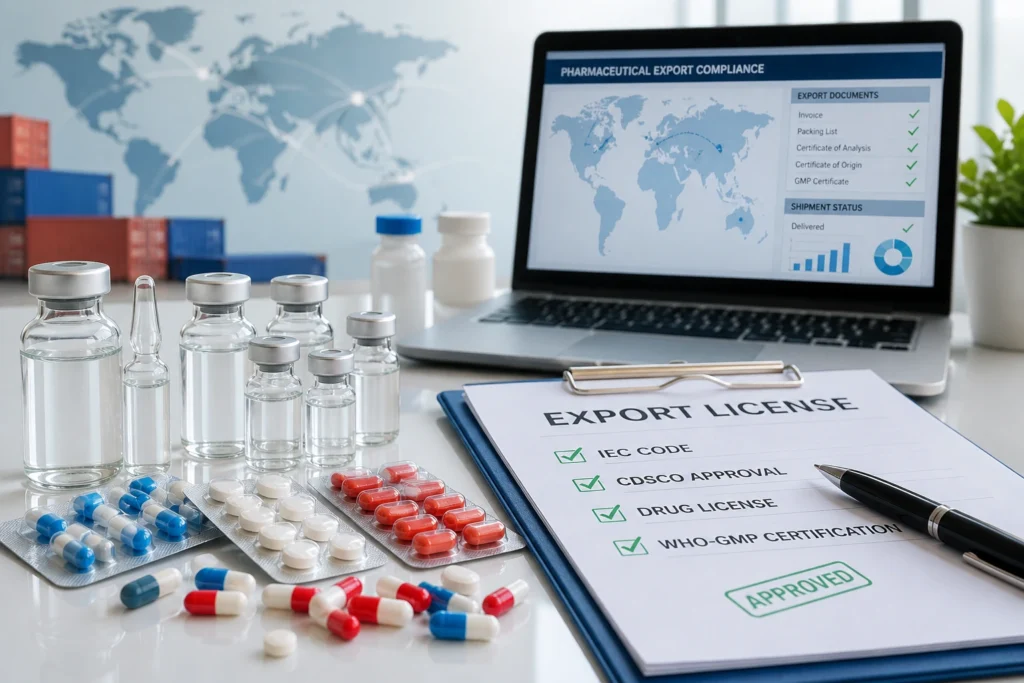
India stands as one of the biggest pharmaceutical exporters globally. The country supplies generic medicines, bulk drugs, and healthcare products to over 200 nations. With such massive global demand, many entrepreneurs and businesses want to enter the pharma export market.
But here is the thing: you cannot simply ship medicines out of India without the proper licenses. Exporting pharmaceutical products requires specific legal approvals from government authorities. Without them, your business risks heavy penalties or even a complete shutdown.
Many beginners get confused about which licenses are needed, how to apply, and how long the process takes. In this guide, you will learn everything about pharmaceutical export licenses in India, from types of licenses to the step-by-step process, documents, costs, and timelines.
What is a Pharmaceutical Export License in India?
A pharmaceutical export license is a legal authorization that allows a company or individual to export medicines, drugs, or pharmaceutical products from India to other countries. It proves that the exporter meets national and international quality and safety standards.
In India, two main authorities govern pharmaceutical exports:
⦁ CDSCO (Central Drugs Standard Control Organisation): Regulates drug quality, approvals, and licensing.
⦁ DGFT (Directorate General of Foreign Trade): Handles import-export codes and foreign trade policies.
It is important to understand the difference between a manufacturing license and an export license. A manufacturing license allows you to produce medicines. An export license allows you to sell those medicines in foreign markets. Both are often required for a complete pharma export operation.
Why is Pharmaceutical Export License Required?
Exporting medicines is not like exporting regular goods. Pharmaceutical products directly impact human health. That is why the Indian government and international buyers require exporters to have valid licenses and certifications.
Key reasons why a pharmaceutical export license is required:
⦁ Safety and Quality Assurance: Licensed exporters must meet Schedule M compliance and WHO-GMP certification standards, ensuring medicines are safe for global consumers.
⦁ International Compliance: Importing countries have their own drug regulations. Indian exporters must meet both Indian and destination-country requirements.
⦁ Avoid Legal Penalties: Exporting medicines without a license can lead to seizure of goods, heavy fines, and criminal charges.
⦁ Build Trust with Global Buyers: A licensed exporter with WHO-GMP-certified products is more credible in international markets like Africa, the Middle East, and Southeast Asia.
Types of Licenses Required for Pharma Export in India
There is no single “pharma export license.” You actually need a set of approvals and registrations to legally export medicines from India. Here is what you need:
1. Import Export Code (IEC) from DGFT
The IEC code is a 10-digit number issued by the Directorate General of Foreign Trade. It is mandatory for any business that wants to import or export goods in India, including pharmaceutical products. Without an IEC code, customs clearance is not possible.
2. Drug License (Form 20/21 or Manufacturing License)
A wholesale drug license (Form 20 and Form 21) is required to store and distribute medicines. If you are manufacturing and exporting, you need a manufacturing license. Both are issued by the State Drug Control Authority.
3. CDSCO Registration for Drug Export
CDSCO approval is required for certain categories of medicines, especially new drugs and those classified under Schedule H or H1. CDSCO also issues export No Objection Certificates (NOCs) when required by the destination country.
4. Product Registration (Country-Specific)
Many countries require the exporter to register the specific medicine product in that country before it can be sold. This is a country-by-country process and can take months depending on the destination regulations.
Step-by-Step Process to Get Pharmaceutical Export License in India
Here is a simplified step-by-step guide for beginners:
1. Register Your Company
Register your business as a Private Limited Company, LLP, or Proprietorship with the Ministry of Corporate Affairs (MCA).
2. Apply for IEC Code
Submit an application on the DGFT portal with your company documents and bank details to obtain your Import Export Code.
3. Obtain Drug License
Apply to the State Drug Control Authority for a wholesale or manufacturing drug license depending on your business model.
4. Register with CDSCO
Depending on your product category, apply for CDSCO approval or export NOC through the online Sugam portal.
5. Get Product Approval for Export
Prepare product dossiers and file for product registration in your target export countries.
6. Prepare Documentation and Compliance
Ensure your products meet WHO-GMP and Schedule M compliance standards before shipping.
Documents Required for Pharma Export License
Having the right documents ready can speed up your license approval. Here is a list of typically necessary documents:
⦁ Company Registration Certificate (MCA)
⦁ IEC Certificate (from DGFT)
⦁ Drug License Copy (Form 20/21 or manufacturing license)
⦁ Product Details (composition, category, formulation)
⦁ WHO-GMP Certification or Schedule M compliance proof
⦁ Quality Compliance Documents (COA, test reports)
⦁ PAN Card, GST Registration, and Bank Account Proof
Cost of Pharmaceutical Export License in India
The total cost varies based on your product category, company size, and the countries you plan to export to. Here is an approximate breakdown:
⦁ IEC Code Application: Rs. 500 (Government fee, minimal)
⦁ Drug License (Wholesale): Rs. 3,000 to Rs. 10,000 (varies by state)
⦁ CDSCO Registration/NOC: Rs. 1,500 to Rs. 50,000+ (depending on product and category)
⦁ WHO-GMP Certification: Rs. 50,000 to Rs. 2,00,000+ (manufacturer-dependent)
⦁ Product Registration (per country): Rs. 30,000 to Rs. 5,00,000+ (varies widely)
Always account for consultant fees, documentation charges, and compliance costs as hidden expenses. These can significantly add to the overall investment.
Time Required to Get Pharma Export License
Getting all required licenses is not an overnight process. Here is a realistic timeline:
⦁ IEC Code: 1 to 3 working days
⦁ Drug License: 2 to 6 weeks (depends on state authority)
⦁ CDSCO Approval/NOC: 2 to 8 weeks
⦁ Country-Specific Product Registration: 3 to 18 months (varies by country)
Overall, from company setup to first export shipment, businesses should plan for at least 4 to 12 weeks for domestic licenses. Adding international product registration can extend the timeline significantly.
Common Mistakes to Avoid in Pharma Export Licensing
Many new exporters face unnecessary delays or rejections due to avoidable mistakes. Below are the most prevalent ones to be cautious of:
⦁ Incomplete Documentation: Missing even one certificate can delay your application by weeks. Always prepare a complete document checklist before applying.
⦁ Ignoring Country-Specific Regulations: Each country has its own rules for drug imports. Not researching destination-country requirements is a costly mistake.
⦁ Lack of Compliance Knowledge: Not understanding Schedule M, WHO-GMP, or pharmaceutical regulatory compliance can result in license rejection.
⦁ Exporting Without Proper Licenses: Attempting to ship medicines without complete approvals exposes your business to serious legal risk.
How to Start a Pharmaceutical Export Business in India
Beyond licensing, starting a successful pharma export business requires smart planning. Concentrate on the following points:
⦁ Market Research: Identify which countries have high demand for generic medicines. Key markets include UAE, Oman, Nigeria, Kenya, Ethiopia, and South Africa.
⦁ Choose Your Product Range: Decide whether you will export generic tablets, injectables, syrups, or bulk drugs. Start with a focused range before expanding.
⦁ Find Reliable Buyers: Use platforms like TradeIndia, Alibaba, and pharma trade shows to connect with international distributors and buyers.
⦁ Plan Logistics and Supply Chain: Partner with reputable freight forwarders who specialize in pharmaceutical shipments to ensure cold chain compliance and timely delivery.
Simplify Pharma Export with an Experienced Partner
Pharmaceutical export licensing is a detailed process. It involves multiple government authorities, strict documentation requirements, and ongoing compliance management. For most businesses, especially new entrants, this can be overwhelming.
This is where partnering with an experienced pharmaceutical exporter makes all the difference. Rizochem is a trusted pharmaceutical exporter from India with deep expertise in global medicine supply. The company handles everything from documentation and regulatory compliance to high-quality generic medicine supply and reliable international logistics.
Want to skip the compliance headache? Contact Rizochem today and get expert guidance on pharmaceutical exports.
Why Choose Rizochem for Pharmaceutical Export?
Rizochem stands out as a reliable and experienced pharma exporter from India. Here is why businesses worldwide trust Rizochem:
⦁ WHO-GMP Compliant Products: Every product meets international quality standards, ensuring acceptance in regulated and semi-regulated markets.
⦁ Wide Range of Generic Medicines: Rizochem supplies tablets, capsules, injectables, syrups, and bulk drugs across multiple therapeutic categories.
⦁ Global Export Experience: With export presence across Africa, the Middle East, and Southeast Asia, Rizochem understands what different markets require.
⦁ Regulatory Expertise: Rizochem assists with documentation, CDSCO filings, and country-specific product registrations to reduce burden on partners.
⦁ Reliable Logistics: Timely delivery with proper cold chain management and tracking for pharmaceutical shipments.
Ready to export medicines from India? Request a quote from Rizochem and start your pharma export journey with confidence.
Frequently Asked Questions (FAQs)
Q1. What license is required to export medicines from India?
You need an IEC code from DGFT, a drug license (wholesale or manufacturing) from the State Drug Authority, and in some cases CDSCO registration or an export NOC. Country-specific product registration may also be required.
Q2. Is CDSCO approval mandatory for all pharma exports?
Not always. CDSCO approval or export NOC is required for certain drug categories, particularly Schedule H, H1 drugs, and new drugs. Standard generic medicines may not require a CDSCO NOC for export, but it is advisable to verify based on your product.
Q3. Can I export medicines from India without a license?
No. Exporting medicines without the required licenses is illegal under the Drugs and Cosmetics Act, 1940. It can result in seizure of goods, financial penalties, and criminal prosecution.
Q4. How much does a pharma export license cost in India?
Basic costs start from a few thousand rupees for an IEC code and drug license. However, when you include WHO-GMP certification, CDSCO fees, and product registration costs for export countries, the total investment can range from Rs. 1 lakh to several lakhs depending on scope.
Q5. How long does it take to get a pharma export license in India?
Getting an IEC code can take just 1 to 3 days. A drug license takes 2 to 6 weeks. CDSCO approvals may take 2 to 8 weeks. Country-specific product registration can take anywhere from 3 months to over a year. Plan for a minimum of 4 to 12 weeks to complete domestic licensing.
Q6. What is the difference between a wholesale drug license and an export license?
A wholesale drug license allows you to purchase, store, and sell medicines domestically. An export-specific setup requires a wholesale license plus an IEC code and any additional product-specific approvals. There is no single standalone “export license” in India; rather, it is a combination of licenses.
Q7. How can I partner with Rizochem for pharma export?
You can get in touch with Rizochem directly through their website to discuss your requirements, product range, and target markets. Rizochem offers end-to-end support for pharmaceutical exporters and suppliers worldwide.
Conclusion
Getting a pharmaceutical export license in India involves multiple steps, approvals, and ongoing compliance management. From obtaining an IEC code and drug license to securing CDSCO registration and product approvals for foreign markets, the journey requires careful planning and expert knowledge.
The good news is that India has a well-defined regulatory framework that, once navigated properly, opens doors to a massive global pharmaceutical market. Generic medicines from India are trusted and in demand across Africa, the Middle East, Southeast Asia, and beyond.
If you want to start exporting without the hassle of managing complex compliance and paperwork on your own, partnering with an experienced exporter is the smarter path. Rizochem brings years of industry experience, global reach, and a commitment to quality that gives your export business a solid foundation.