

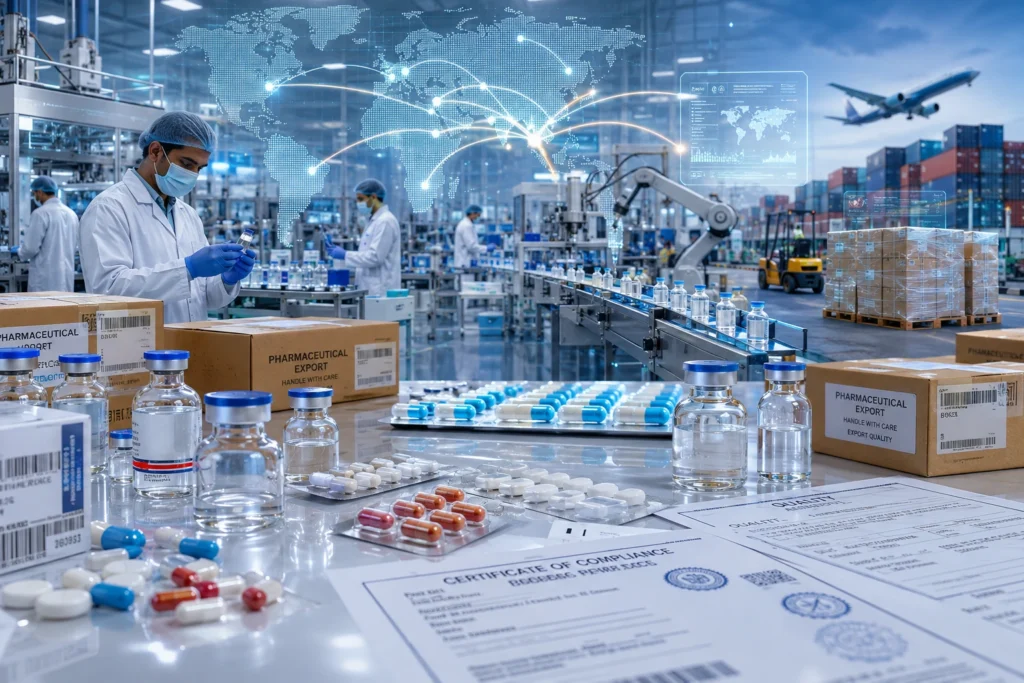
Over the past two decades, India has built one of the most formidable pharmaceutical export ecosystems in the world. From remote clinics in sub-Saharan Africa to advanced hospitals across Europe, medicines manufactured in India reach patients in more than 200 countries every single day. This is not a coincidence — it is the outcome of deliberate investment in manufacturing capacity, regulatory compliance, scientific talent, and cost-efficient production systems.
The phrase “Pharmacy of the World” is no longer just a marketing label. It reflects a measurable reality: India accounts for roughly 20% of global generic medicine exports by volume, supplies over 50% of Africa’s generic drug demand, and fulfills a significant share of antiretroviral treatments procured globally. In 2026, this leadership position continues to strengthen as new markets open, biosimilars gain momentum, and digital supply chain tools improve delivery reliability.
This report examines the core reasons why Indian pharmaceutical exports command such widespread trust — from manufacturing standards and certifications to pricing models, supply chain robustness, and emerging market expansion. Whether you are a procurement officer, a global health partner, or an industry analyst, this analysis offers a grounded view of what makes India’s pharmaceutical export sector so dependable.
1. Overview of the Indian Pharmaceutical Export Industry
Current Size and Export Revenue in 2026
India’s pharmaceutical export industry has maintained steady upward momentum. In the financial year 2024-25, exports crossed USD 27 billion, with projections for 2025-26 pointing toward the USD 30 billion mark. Generic medicines, active pharmaceutical ingredients (APIs), vaccines, and specialty drugs collectively drive this revenue. The sector employs over 3.5 million people directly and supports a vast indirect ecosystem of logistics, packaging, raw material supply, and regulatory services.
Major destination markets for Indian pharmaceutical exports include the United States (which absorbs the largest share by value), the United Kingdom, South Africa, Nigeria, Brazil, Russia, and key Gulf Cooperation Council (GCC) states. The US market alone accounts for approximately 30% of total export value, thanks to India’s strong base of US FDA-approved manufacturing plants.
India’s Position in Global Pharma Markets
India ranks among the top five global pharmaceutical producers by volume and holds the distinction of being the world’s largest supplier of generic medicines. The country’s contribution to global healthcare accessibility is particularly visible in low- and middle-income countries where affordability determines whether patients receive treatment at all. Indian manufacturers have made it commercially viable to provide essential medicines at prices that governments and international procurement agencies can realistically sustain.
2. Why Indian Pharmaceutical Exports Are Trusted Worldwide
Strong and Scalable Manufacturing Infrastructure
India’s pharmaceutical manufacturing base is both large and sophisticated. The country hosts over 10,500 registered pharmaceutical manufacturing units, with more than 650 plants approved by the US FDA — a number that exceeds those of any other country outside the United States itself. Dedicated pharmaceutical clusters in Hyderabad, Ahmedabad, Pune, Mumbai, and Baddi operate with high production standards, automated quality systems, and significant output capacity.
This infrastructure allows Indian manufacturers to handle large-volume global procurement contracts without compromising on consistency or lead times. For international buyers sourcing millions of tablets or vials in a single order, this scale reliability is a fundamental requirement — and Indian manufacturers consistently deliver it.
Affordable Generic Medicines Without Compromising Quality
One of the most powerful drivers of trust in Indian pharmaceutical exports is the price advantage. Generic medicine production in India benefits from lower labor costs, established bulk drug manufacturing clusters, a strong domestic chemical industry for raw material supply, and decades of production experience that have driven efficiency gains. The result is that Indian manufacturers can offer equivalent therapeutic outcomes at a fraction of the cost compared to originator brands.
This affordability is not achieved by cutting corners on quality. Indian pharmaceutical companies invest heavily in quality assurance infrastructure, including in-house laboratories, dissolution testing, stability studies, and packaging integrity checks. The combination of low price and verified quality is what makes Indian generic medicines the preferred choice for governments, international NGOs, and private healthcare buyers alike.
Consistent Product Quality Backed by Rigorous Testing
Quality in pharmaceutical manufacturing is not a single checkpoint — it is a continuous process embedded at every stage from raw material procurement to final product release. Indian pharmaceutical exporters operating in regulated markets maintain quality management systems aligned with internationally recognized standards. Batch release protocols, pharmacopoeial testing (IP, BP, USP), microbiological screening, and stability testing under ICH guidelines are standard practices among established exporters.
3. International Certifications and Regulatory Compliance
WHO-GMP Certified Pharmaceutical Companies
WHO-GMP (Good Manufacturing Practice) certification is the baseline quality standard for pharmaceutical manufacturers supplying to developing and middle-income country markets. A significant number of Indian pharmaceutical manufacturing sites hold WHO-GMP certification, which signals to procurement agencies like UNICEF, PAHO, and the Global Fund that the facility meets international standards for manufacturing hygiene, process control, documentation, and quality assurance.
For many African and Asian governments that procure medicines through international tenders, WHO-GMP certification is a mandatory qualification. Indian manufacturers have made this a standard credential, enabling them to participate in and win large-scale public health procurement contracts across the developing world.
US FDA and EU GMP Approved Plants
Access to regulated markets — particularly the United States and the European Union — requires a higher tier of compliance. The US FDA conducts rigorous inspections of overseas manufacturing facilities before approving them to supply the American market. Indian pharmaceutical companies have collectively invested hundreds of millions of dollars in facility upgrades, documentation systems, and quality personnel to achieve and maintain FDA approval.
Similarly, EU GMP compliance allows Indian manufacturers to supply medicines to European markets, where safety standards are among the most stringent in the world. Having dual-regulated status (both FDA and EU GMP) is increasingly common among India’s top-tier exporters, which significantly expands their market access and reinforces buyer confidence globally.
CDSCO and Domestic Regulatory Framework
Within India, the Central Drugs Standard Control Organisation (CDSCO) governs pharmaceutical manufacturing, licensing, and export approvals. Indian pharmaceutical exporters must obtain a Certificate of Pharmaceutical Product (CoPP) for international shipments, which certifies that the product is manufactured under GMP conditions approved by the Indian regulatory authority. This domestic oversight layer adds an additional assurance mechanism for importing countries.
4. India’s Strength in Generic Medicines and APIs
World’s Largest Generic Medicine Supplier
Generic medicines form the backbone of India’s pharmaceutical export profile. India manufactures generics across virtually every therapeutic category — cardiovascular, anti-infective, oncology, central nervous system, diabetes, respiratory, and more. The sheer breadth of the product portfolio means that a single Indian supplier can often fulfill multiple category requirements for international buyers, reducing supply chain complexity.
Indian generic manufacturers have demonstrated the ability to bring affordable versions of patented medicines to market rapidly following patent expiry, particularly in the US market where Para IV filings (challenging existing patents) have become a competitive strength. This agility in the generics pipeline is a key differentiator from manufacturers in other countries.
API Manufacturing Leadership
Active pharmaceutical ingredients (APIs) — the core chemical components that give medicines their therapeutic effect — are another major export category for India. The country is one of the world’s largest API producers, supplying bulk drugs to pharmaceutical manufacturers in Europe, the US, and Asia. Major API production clusters in Hyderabad’s Genome Valley and Gujarat’s Ankleshwar region have established India as an indispensable node in the global pharmaceutical supply chain.
Indian API manufacturers supply a significant share of the raw materials used in medicines manufactured in other countries. This upstream position means that India’s pharmaceutical influence extends well beyond its own finished product exports, shaping the cost and availability of medicines produced globally.
Critical Role During Global Health Emergencies
India’s pharmaceutical export capacity proved its strategic value during global health crises. During the COVID-19 pandemic, India was the world’s largest vaccine manufacturer and a critical supplier of essential medicines including hydroxychloroquine, paracetamol, and personal protective equipment inputs. The Serum Institute of India alone produced and exported hundreds of millions of vaccine doses, demonstrating that India’s manufacturing infrastructure can scale rapidly under emergency conditions.
India has also been a primary supplier of antiretroviral (ARV) medicines for HIV/AIDS treatment programs in Africa, providing over 40% of ARV medicines procured by PEPFAR (the US President’s Emergency Plan for AIDS Relief). This life-saving role has cemented India’s reputation as a dependable supplier when global health is at stake.
5. Advanced Pharmaceutical Supply Chain and Logistics
Export-Ready Pharmaceutical Packaging
Pharmaceutical packaging is far more than aesthetics — it directly affects product safety, shelf life, and regulatory compliance. Indian pharmaceutical exporters maintain packaging standards aligned with destination market requirements, whether that means child-resistant closures for US retail markets, blister packs compliant with European pharmacopoeial standards, or heat-sealed sachets for tropical climates. Printing accuracy for dosage instructions, expiry dates, and batch numbers is subject to documented quality checks before shipment.
Global Distribution Network
India’s major pharmaceutical export hubs — Mumbai (JNPT), Hyderabad, Ahmedabad, and Chennai — are connected to global shipping routes with well-established freight forwarding relationships. Leading Indian pharmaceutical companies have built partnerships with global logistics providers who understand the regulatory requirements for pharmaceutical shipments, including controlled substance documentation, temperature excursion monitoring, and customs clearance protocols in destination countries.
The distribution network supports timely delivery to Africa, the Middle East, Southeast Asia, Europe, and the Americas. For buyers in landlocked African nations or GCC countries with specific import regulations, experienced Indian exporters can navigate these complexities reliably.
Cold Chain and Storage Infrastructure
Biologics, vaccines, and certain specialty medicines require continuous cold chain management from manufacture to delivery. Indian pharmaceutical exporters involved in vaccine distribution and biosimilar exports have invested in cold chain infrastructure including refrigerated warehouses at port locations, temperature-validated packaging systems, and real-time monitoring during air freight. This capability is critical for expanding into high-value biologic and specialty medicine exports, which represent the next wave of growth for the sector.
6. Key Countries Importing Medicines from India
Pharmaceutical Exports to Africa
Africa represents one of India’s most important and growing pharmaceutical export markets. South Africa, Nigeria, Kenya, Ethiopia, Tanzania, and Uganda collectively import large volumes of generic medicines, ARVs, and APIs from India. The continent’s healthcare systems rely heavily on affordable generic medicines to address high disease burdens of malaria, tuberculosis, HIV/AIDS, and non-communicable diseases. Indian pharmaceutical suppliers have established long-term procurement relationships with African governments and international health organizations working across the continent.
Pharma Supply to the Middle East and GCC
The UAE, Saudi Arabia, Jordan, Kuwait, and Qatar are significant importers of Indian pharmaceutical products. The GCC market is particularly valuable because it includes both a large expatriate population familiar with Indian medicine brands and a growing domestic healthcare sector seeking cost-effective procurement options. Jordan serves as a pharmaceutical distribution hub for the broader Levant region, and Indian exporters have built strong trade relationships with Jordanian distributors and government procurement agencies.
Shipments to Controlled Markets in Europe and North America
Regulated markets in the United States, United Kingdom, Canada, Germany, France, and Australia demand the highest compliance standards but also offer the strongest margins and the most durable commercial relationships. Indian pharmaceutical companies that have invested in obtaining and maintaining US FDA and EU GMP approvals now supply generics to retail pharmacy chains, hospital formularies, and government health programs in these markets. The US remains the single largest destination by value, where Indian generics help reduce healthcare costs for millions of American patients.
7. Emerging Trends in Indian Pharma Exports for 2026
Growth in Biosimilars and Specialty Medicines
Biosimilars — biological medicines that are highly similar to already-approved biologic drugs — represent one of the highest-growth segments for Indian pharmaceutical exports. As major biologics face patent expiry through the late 2020s, Indian companies including Biocon, Dr. Reddy’s Laboratories, and Cipla have built biosimilar pipelines targeting oncology, autoimmune disease, and diabetes indications. These high-value products command significantly better margins than traditional small-molecule generics and are drawing international partnership interest from European and American healthcare providers.
Digital Pharmaceutical Supply Chain Transformation
Indian pharmaceutical exporters are integrating digital tools across the supply chain to improve traceability, reduce errors, and satisfy increasingly stringent serialization requirements in the US and EU. Track-and-trace systems, electronic batch records, AI-powered quality deviation detection, and digital documentation platforms are being adopted by forward-looking companies. These investments improve export readiness and reduce the risk of shipment rejections at destination ports due to documentation discrepancies.
Sustainable Pharmaceutical Manufacturing
Environmental compliance and sustainability reporting are becoming prerequisites for doing business with European healthcare purchasers and global health organizations. Indian pharmaceutical companies are responding by investing in effluent treatment upgrades, renewable energy integration in manufacturing facilities, green chemistry approaches to API synthesis, and ISO 14001 environmental management certification. This positions them favorably as international buyers increasingly incorporate sustainability criteria into procurement decisions.
Expansion of Contract Manufacturing Services
Contract Development and Manufacturing Organization (CDMO) services from India are gaining traction as global pharmaceutical companies seek to reduce manufacturing costs without compromising quality. .Indian CDMOs provide comprehensive services that range from process development to large-scale manufacturing, bolstered by formulation knowledge, analytical skills, and regulatory document preparation. This segment is growing rapidly, bringing in foreign investment and technology partnerships that further upgrade India’s manufacturing capabilities.
8. Challenges Facing Indian Pharmaceutical Exporters
Navigating Evolving Global Regulatory Requirements
Regulatory requirements in major markets are continuously updated, and keeping pace with these changes demands significant compliance investment. US FDA import alerts, EU GMP non-compliance citations, and data integrity scrutiny have affected some Indian manufacturers in recent years. The industry has responded with more robust quality management training, third-party auditing, and increased engagement with regulatory consultants — but maintaining compliance across multiple regulated markets simultaneously remains an ongoing operational challenge.
Supply Chain Disruptions and Raw Material Dependencies
India’s API manufacturing has a significant dependence on Chinese raw material imports for certain chemical intermediates. Geopolitical tensions, trade restrictions, or logistics disruptions in this supply relationship can create production bottlenecks that affect export delivery timelines. The Indian government and industry have responded with initiatives to build domestic intermediate chemical manufacturing capacity, but this transition requires time and investment.
Intensifying Competition from Other Markets
China, South Korea, Bangladesh, and several Eastern European countries are developing their pharmaceutical export capabilities. While India’s head start in regulatory approvals, production scale, and global market relationships provides a durable competitive moat, the competitive landscape is gradually intensifying — particularly in API supply, where Chinese manufacturers benefit from lower intermediate chemical costs.
Pricing Pressure in Generic Medicines
The generic medicine market is inherently price-competitive, and margins have compressed over the years particularly in the US generics segment. The entry of multiple generic competitors for the same molecule, combined with consolidation among US pharmacy benefit managers, has driven down average selling prices. Indian manufacturers are responding by diversifying into higher-value specialty generics, complex formulations, and biosimilars where competition is lower and margins are more sustainable.
9. Future Outlook for India’s Pharmaceutical Export Industry
Expected Export Growth Through 2030
Industry forecasts project India’s pharmaceutical exports to reach USD 65-70 billion by 2030, driven by expanding generic medicine volumes, biosimilar launches, CDMO revenue growth, and deeper penetration into African and Southeast Asian markets. Government support through production-linked incentive (PLI) schemes for pharmaceuticals and APIs is accelerating capacity expansion and attracting new investment into the sector.
Expansion into New International Markets
India’s pharmaceutical exporters are actively developing commercial relationships in markets where penetration has historically been limited — including Latin America, francophone Africa, Central Asia, and parts of Southeast Asia. Free trade agreements and bilateral pharmaceutical cooperation frameworks are creating regulatory pathways that reduce market entry barriers for Indian exporters. The African Continental Free Trade Area (AfCFTA) is expected to create additional opportunities by simplifying intra-African trade logistics that Indian exporters supply into.
India’s Role in Global Healthcare Accessibility
Beyond commercial export metrics, India’s pharmaceutical industry plays a role in global health equity that few other sectors can match. The availability of affordable Indian-manufactured medicines for HIV, tuberculosis, malaria, hepatitis C, and cancer has measurably extended and saved lives across low-income populations worldwide. As global health financing pressures increase, the case for sourcing from India — where quality and affordability intersect — will only grow stronger.
Conclusion
Indian pharmaceutical exports have earned global trust through a combination of factors that are difficult to replicate quickly: decades of manufacturing experience, deep regulatory credibility, genuine cost advantages in generic production, a broad product portfolio spanning APIs to finished formulations, and a proven track record of reliable supply during healthcare crises.
The 2026 landscape reflects an industry that is not resting on its reputation but actively evolving — investing in biosimilars, digital quality systems, sustainability credentials, and CDMO capabilities that will sustain competitiveness through the next decade. For international buyers, healthcare systems, and global health organizations, India offers a pharmaceutical supply partner that combines affordability, compliance, and scale in a combination found nowhere else in the world.
As global healthcare demand rises and the pressure to deliver effective medicines at accessible prices intensifies, India’s pharmaceutical export industry stands well-positioned to serve that need — reliably, at scale, and with the quality assurance that protects patient safety across every market it serves.
Frequently Asked Questions (FAQs)
1. Why are Indian pharmaceutical exports trusted globally?
Indian pharmaceutical exports are trusted because of their combination of rigorous quality standards, international regulatory approvals (including US FDA and WHO-GMP), significant cost efficiency in generic medicine production, and a long track record of reliable supply to over 200 countries. Buyers across regulated and emerging markets consistently validate this trust through long-term procurement partnerships.
2. Which countries import the most medicines from India?
The United States accounts for the largest share by value, followed by the United Kingdom, South Africa, Nigeria, Brazil, Germany, Russia, the UAE, and several other African and Asian nations. India’s export footprint spans both highly regulated markets (US, EU) and developing healthcare economies (Africa, Southeast Asia, Middle East).
3. What certifications do Indian pharmaceutical exporters need?
Key certifications include WHO-GMP for developing market access, US FDA approval for the American market, EU GMP certification for European markets, CDSCO licensing and Certificate of Pharmaceutical Product (CoPP) for export documentation, and ISO quality management certifications.Top exporters generally possess various certifications to reach different international markets at the same time.
4. Why is India called the Pharmacy of the World?
India earns this designation because it is the largest global supplier of generic medicines by volume, produces over 60,000 different generic formulations, supplies more than 50% of Africa’s generic drug demand, and fulfills a major share of global vaccine and antiretroviral medicine requirements. The combination of scale, affordability, and quality is unmatched by any other country.
5. What are the major pharmaceutical products exported from India?
India exports a wide range of pharmaceutical products including generic medicines across all therapeutic categories, active pharmaceutical ingredients (APIs), vaccines, antiretroviral drugs (ARVs) for HIV treatment, oncology medicines, antibiotics, cardiovascular drugs, biosimilars, and specialty pharmaceutical formulations. APIs represent a particularly important export category given India’s role as an upstream supplier to manufacturers worldwide.
6. What is the future of Indian pharmaceutical exports in 2026 and beyond?
The outlook is strongly positive. Export revenues are projected to reach USD 65-70 billion by 2030 driven by biosimilar growth, CDMO sector expansion, deepening market penetration in Africa and Latin America, and government-backed manufacturing incentives. Digital supply chain adoption and sustainability investment are also improving competitiveness in regulated market segments where compliance requirements continue to raise the bar.